
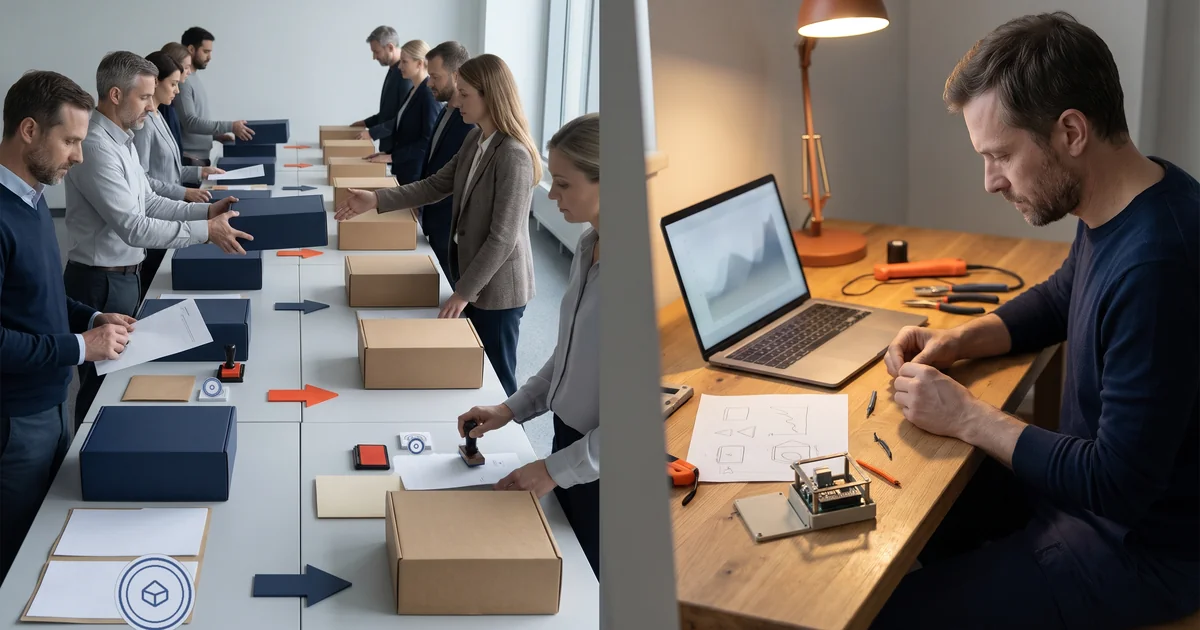
In October 2026 I attended the “AI Transformation of Healthcare” conference, organized by the Czech Association of Artificial Intelligence (ČAUI). One idea took shape there so clearly that I wrote it up on LinkedIn. I want to add to it here.
Today, almost all talk about artificial intelligence is about products: how to choose them, roll them out, pay for them and run them safely. That layer is important. And it is mostly about the difficulties — not in the product itself, but around it. Typically integration into existing systems, responsibility for decisions, data protection, who will pay for it once the pilot ends, and above all how people’s work changes and whether they trust it.
Top-down rollouts are slow and expensive not because of the technology, but because of the organization and its culture. That is as true in a hospital as it is in a factory.
The second layer is harder to see
AI puts into the hands of individuals something that used to belong only to teams of developers, analysts and data scientists: the chance to turn their own curiosity into a working solution. The person who knows the problem best can now build an application, a predictive model or a data analysis themselves, in days rather than months. In principle, their idea no longer has to wait for a budget, a tender or spare capacity in IT.
I don’t mean large programs. I mean things that start at someone’s desk. A quality engineer puts together a picture of recurring defects from photos of faults. A process engineer uses weekly outputs to spot when a machine starts to behave differently. A doctor drafts a checklist from professional guidelines and shares it with colleagues for comment. None of this is an “AI project”. It is someone who sees the problem every day and suddenly has a tool to try something about it.
That, to me, is the real change: who gets to innovate. Innovation stops being the preserve of specialist teams and appears where the problem actually is, so it sidesteps the barriers that stall a rollout from the top.
People are already doing this. Often quietly.
According to the 2024 Work Trend Index survey, commissioned by Microsoft and LinkedIn among 31,000 knowledge workers in 31 countries, 78 % of AI users bring their own tools to work. The survey calls this BYOAI, bring your own AI. It happens without guidance or approval from the top. In the Czech Republic it was 86 % of AI users, and 80 % across Europe as a whole. The same survey finds that 52 % of people who use AI at work are reluctant to admit they use it for their most important tasks.
That is not an ideal state of affairs: if a company does not create the space, people will find it anyway — just without rules, without sharing, and often with data that should never have ended up in a public tool.
A story that is repeating itself
Perhaps innovation from the ground up is simply unstoppable. One legendary anecdote will do.
In the late 1970s the first spreadsheet application, VisiCalc, by Dan Bricklin and Bob Frankston, came out for the Apple II. The Computer History Museum calls it the program that turned the personal computer into a business machine. Shops demonstrated it on the Apple II, and people from companies, often in finance and accounting, added the computer and the software to the order and started calculating at their own desks; as John Naughton described it, it sometimes went on expenses. They could now try for themselves the analyses they used to send to the data-processing department. A few years later, there was a spreadsheet in every office.
I think the same thing is happening with AI, only much faster.
At the same time, I see no reason why the two layers should be mutually exclusive. Products bring scale, reliability and clearly assigned responsibility. Building from the ground up brings speed and knowledge of a specific problem. So the question is not whether to deploy AI, but how to create an environment where people can build, and take their ideas safely all the way to real use.
How to create an environment for building from the ground up
It does not have to be an elaborate program. Four plain rules will do.
First, a protected space to try things out. People need approved tools in which they can experiment. Otherwise they end up on a private account in a public service — precisely the situation companies fear, and often bring on themselves with a ban.
Second, clear rules for data. Patient or customer personal data, trade secrets, credentials and sensitive internal documents do not belong outside; a general description of a problem or an anonymized sample often does. People will follow the rule if they know it and it is short. The worst thing is silence, because in silence everyone sets their own threshold.
Third, guardrails. An experiment is not production: the result of one person’s workshop should not by itself run a line, approve a batch release, or go into a medical record. Before it is used for real, it must be clear who will check it — responsibility stays with the person, not the model.
Fourth, sharing. When something genuinely helps someone, there should be a short way to show it to others and, if appropriate, turn it into a supported tool. Otherwise good ideas stay at one desk, and risky ones still spread quietly.
None of this will stop innovation from the ground up. It can, however, separate it from unnecessary risk and give it a chance to grow.
The obligatory question at the end: how do you see it where you are? Does it make more sense to scale finished products — “off-the-shelf boxes”, if you like — or to give people room to build from the ground up? I lean towards a combination of the two.
I published a shorter version on LinkedIn on 19 October 2026.